You reach for the jar of pasta sauce and your hand just… doesn’t cooperate. You get out of bed and your knees announce themselves before your alarm does. You go to put your hair up and your shoulder says: absolutely not!
If you’re in your 40s or 50s and suddenly feel like you’ve aged twenty years overnight, there’s a name for what’s happening, and it isn’t “getting old.”
Aching joints show up on almost nobody’s “what to expect” list for perimenopause. Hot flashes get all the attention. But joint pain and stiffness are reported by a large share of women during this transition, and hormones are a real, physical part of the reason.1 Aging, weight, and inflammation from diet all play a role too, but the hormonal piece is less mentioned, which is exactly why it’s worth understanding.
Why does perimenopause cause aching joints?
Estrogen has an anti-inflammatory job in your body, and when it starts fluctuating in perimenopause, your joints feel the drop first.
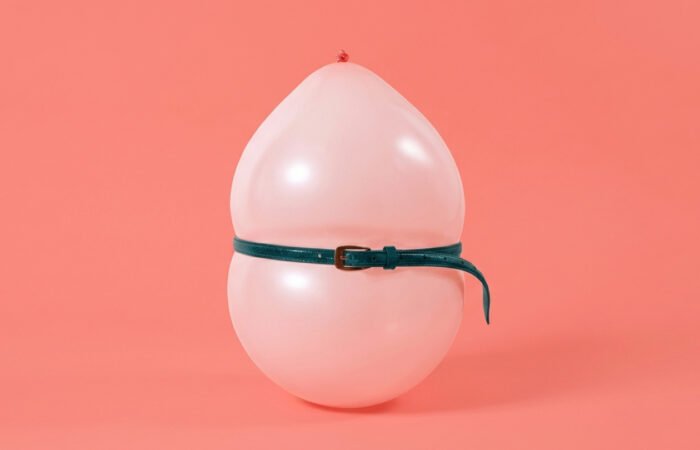
Here’s a way to picture what’s happening inside a joint. Think of each one — your knee, your knuckle, your shoulder — as a small, sealed water balloon sitting between two bones. Inside that balloon is a slippery fluid that lets the bones glide past each other without friction. That balloon has a name (the synovial membrane), and the fluid inside it is called synovial fluid. You don’t need to remember all this, you just need to know that this little cushion system is what makes your joints move smoothly.2
That balloon is lined with tissue that has estrogen receptors all over it, cells that respond directly to estrogen. When estrogen levels are still doing their job without irregular fluctuation, it helps keep that lining calm and the fluid inside well-regulated. When estrogen starts swinging up and down, which is exactly what happens in perimenopause, that calming effect gets inconsistent. The result is low-grade inflammation inside the joint. Not a dramatic flare, just enough irritation to make things ache, stiffen, and feel worse some days than others.3
A 2021 study looking directly at knee cartilage found that women with osteoarthritis had significantly higher levels of these estrogen receptors than women without it, and that the loss of estrogen appears to be a real risk factor for joint degeneration, not just a coincidence of aging.4 It’s also why so many women notice their joint pain isn’t steady. It comes and goes with how erratic their cycle is that month, and some people even say the weather (specifically barometric pressure) seems to make it worse, which tracks with how sensitive this system is to change.
Which joints are most commonly affected?
Hands, knees, hips, and shoulders take the brunt of it, and shoulders in particular can develop a specific, nasty condition worth knowing about by name.
Knees and hips carry your body weight, so they tend to be where hormone-driven joint changes show up alongside ordinary wear and tear. A broader review of estrogen and joint health points to hips as a similarly affected area as the knee.5 Hands are extremely common too, especially the small joints in your fingers, and this one is almost entirely reported through lived experience rather than large studies — which is part of why it gets missed. If your hands ache and you’ve never had an issue before, perimenopause is a reasonable explanation worth raising with a doctor.
Frozen shoulder: the one nobody warns you about
Somewhere in every garage, there’s a garden hose that got left outside over winter. By spring, it’s not just stiff… it’s kinked in a shape it refuses to let go of, and you’re standing there wrestling it like it owes you money. That’s basically what happens to a shoulder that’s been quietly losing estrogen for a year: it doesn’t announce itself, it just slowly seizes up until one day reaching for a seatbelt feels like defusing a bomb.
Shoulders deserve their own callout, because there’s a specific condition known as frozen shoulder (medically called adhesive capsulitis) that’s increasingly understood as hormone-driven, and it can be genuinely disruptive if it’s caught late. It starts as an ache, often when you reach behind your back or overhead. Left alone, the shoulder capsule can thicken and stiffen to the point where you can’t do simple things like fasten a bra or put your hair in a ponytail. It affects women at higher rates than men, and it clusters heavily around the late 40s.6
Why the shoulder specifically? Tendon tissue in the shoulder (including the rotator cuff, the group of tendons that wraps around the joint) has been found to carry a particularly high concentration of estrogen and progesterone receptors in postmenopausal women, more than in men of the same age.7 A recent review goes further, framing frozen shoulder as something closer to a whole-body hormonal and metabolic event than a purely mechanical shoulder problem, tied to estrogen decline, thyroid function, and inflammation levels more broadly.8
How long does frozen shoulder last?
Without treatment, it can take one to two years to fully resolve, moving from the “frozen” to the “thawing” phase. The good news is that early treatment such as physiotherapy, anti-inflammatory medication, or a corticosteroid injection, is linked to a shorter, less painful course, which is exactly why catching it early instead of waiting it out matters.9
But, it’s worth knowing that this isn’t a simple “more estrogen, healthier shoulder” story. A large study on younger women found that those using hormonal birth control actually had higher odds of rotator cuff tears and other shoulder issues, not lower.10 Estrogen clearly matters to shoulder tissue… it’s just not a straight line, and it’s a good reminder that hormone therapy decisions are individual, not one-size-fits-all.
There’s also a knock-on effect worth knowing about: shoulder pain changes how you move on that side, and that asymmetry often creates neck tension you wouldn’t think to connect to your shoulder. If headaches have shown up around the same time as your shoulder pain, tension from compensating for it is a common, overlooked cause — worth mentioning alongside the shoulder itself.
Perimenopause joints vs. arthritis: how to tell the difference
This is the question worth asking before you assume the worst. Perimenopause-related joint pain tends to be widespread rather than confined to one joint, fluctuates from day to day or week to week, and shows up as stiffness or a dull ache rather than visible inflammation. Arthritis, on the other hand, tends to be more localized, and comes with signs beyond pain. A joint that’s genuinely red, warm to the touch, or swollen is a signal that something more specific than hormones is going on.11
Is this arthritis or is it perimenopause?
According to Coral’s medical director, Dr. Ariane Ouellet-Decoste, a few details go a long way toward telling the two apart. Pain that’s spread across several joints, fluctuates day to day, and isn’t paired with any warmth, swelling, or visible redness points away from arthritis and toward the hormonal picture.
A joint that’s warm, swollen, or visibly red, or a family history of autoimmune or inflammatory joint disease is a reason to have that specific joint properly examined, since it suggests something beyond hormones may be involved.
How fatigue and pain feed each other
Poor sleep doesn’t just make you tired. It turns up your body’s inflammation and makes existing joint pain feel worse, which then disrupts sleep further.
If you’ve noticed that a bad night’s sleep seems to make your joints ache more the next day, that’s not a coincidence. Sleep is when your body actively lowers inflammation and keeps your immune system running properly. When perimenopause disrupts your sleep (and it frequently does unfortunately) that housekeeping doesn’t happen as well, and pain perception goes up. A recent review of menopause-related pain identified sleep disruption as one of the most consistent factors that makes musculoskeletal pain worse across the transition, describing it as a two-way cycle: pain disrupts sleep, and poor sleep amplifies pain.12
This is also where cortisol, your body’s main stress hormone, tends to come up. Chronic stress and disrupted sleep both push cortisol higher, and elevated cortisol is linked to more inflammation and a lower pain threshold. This is one more reason perimenopause fatigue and joint aches so often show up as a package deal rather than separate, unrelated complaints. If you’re dealing with both low estrogen symptoms and fatigue that won’t quit, they’re very likely connected, not two unrelated problems to solve separately.
Natural approaches to joint pain relief
It feels counterintuitive, but the biggest lever most people can pull is moving the joint, not resting it. Gentle, consistent movement such as walking, swimming, and mobility work is associated with less pain and stiffness over time than staying still, even though it’s uncomfortable to start. A review focused specifically on perimenopausal knee pain backs this up, pointing to physical therapy and regular movement as some of the best-supported non-drug options available.13
Carrying less weight through your joints also matters. Weight management is one of the more consistently supported strategies for reducing joint strain in women going through hormonal changes, alongside general anti-inflammatory eating patterns (more vegetables, less ultra-processed food and added sugar).14
Omega-3 and turmeric (curcumin) come up constantly in menopause forums, and the honest answer is that the evidence is not settled yet. A 2025 lab study found that curcumin combined with omega-3 reduced pain and protected cartilage in an animal model of osteoarthritis. This is encouraging, but it’s not the same as proof it works this way in perimenopausal women.15 It’s reasonable to try either one for a few months as part of a broader plan, ideally in conversation with whoever’s managing your care, rather than expecting it to be a fix on its own.
Does HRT help with joint pain?
Because estrogen decline is a driving factor behind hormone-related joint pain, replacing it is one of the more logical treatment approaches available, and it’s part of why hormone therapy comes up so often in this conversation. A large randomized trial within the Women’s Health Initiative looked specifically at joint symptoms in women taking estrogen alone and found real, measurable improvement in joint pain and stiffness compared to placebo.16 A separate WHI trial looking at hormone therapy’s effect on rheumatoid arthritis specifically found a non-significant trend toward improved joint pain scores — not a slam dunk, but consistent with a real effect that’s still being fully understood.17
This tracks with what Dr. Ouellet-Decoste sees clinically: many women who start hormone therapy for other perimenopause symptoms notice their joint pain improves too, even though it wasn’t the reason they started. Hormone therapy doesn’t reverse existing joint damage, but by easing hot flashes and improving sleep, it can calm the same inflammation cycle covered earlier in this article. This is likely part of why some women notice meaningfully less day-to-day joint pain once their other symptoms settle down.
Twenty years older isn’t a diagnosis
So if your knees, hands, or shoulders have been acting like they belong to someone twenty years older, the fix isn’t necessarily more stretching or a new mattress. It might be your hormones.
Joint pain alone isn’t a reason to go on hormone therapy. If you’re also dealing with other perimenopause symptoms, your Coral care team can walk through the full picture with you and figure out what your options are.
Disclaimer: The information provided here is for informational purposes only. It is not intended as medical advice. Always consult with your doctor or healthcare provider to determine what is best for your individual health needs.
While we use the word “women” for simplicity, we recognize that menopause and perimenopause can affect people of many gender identities. Our goal is to support everyone who experiences these changes.
Sources:
- Ertmane, E., & Lulle, A. (2026). Menopause-associated pain: a decade review of patterns, determinants, and research priorities. Menopause (New York, N.Y.), 10.1097/GME.0000000000002842. Advance online publication. https://doi.org/10.1097/GME.0000000000002842 ↩︎
- Hui, A. Y., McCarty, W. J., Masuda, K., Firestein, G. S., & Sah, R. L. (2012). A systems biology approach to synovial joint lubrication in health, injury, and disease. Wiley interdisciplinary reviews. Systems biology and medicine, 4(1), 15–37. https://doi.org/10.1002/wsbm.157 ↩︎
- Roman-Blas, J. A., Castañeda, S., Largo, R., & Herrero-Beaumont, G. (2009). Osteoarthritis associated with estrogen deficiency. Arthritis research & therapy, 11(5), 241. https://doi.org/10.1186/ar2791 ↩︎
- Hughbanks, M. L., Rodriguez-Fontan, F., Kleck, C. J., & Burger-Van der Walt, E. (2021). Estrogen receptor Alpha in human knee articular cartilage of healthy and osteoarthritic females. Journal of orthopaedics, 27, 1–8. https://doi.org/10.1016/j.jor.2021.08.005 ↩︎
- Zhao, H., Yu, F., & Wu, W. (2025). The Mechanism by Which Estrogen Level Affects Knee Osteoarthritis Pain in Perimenopause and Non-Pharmacological Measures. International journal of molecular sciences, 26(6), 2391. https://doi.org/10.3390/ijms26062391 ↩︎
- Mullen, J. P., Hauer, T. M., Lau, E. N., & Lin, A. (2025). Adhesive Capsulitis of the Shoulder. Arthroscopy : the journal of arthroscopic & related surgery : official publication of the Arthroscopy Association of North America and the International Arthroscopy Association, 41(7), 2176–2178. https://doi.org/10.1016/j.arthro.2025.03.027 ↩︎
- Longo, U. G., Mazzola, A., Carotti, S., Francesconi, M., Catapano, S., Magrì, F., Perrone, G., Morini, S., De Salvatore, S., & Denaro, V. (2021). The role of estrogen and progesterone receptors in the rotator cuff disease: a retrospective cohort study. BMC musculoskeletal disorders, 22(1), 891. https://doi.org/10.1186/s12891-021-04778-5 ↩︎
- Navarro-Ledesma S. (2025). Frozen Shoulder as a Systemic Immunometabolic Disorder: The Roles of Estrogen, Thyroid Dysfunction, Endothelial Health, Lifestyle, and Clinical Implications. Journal of clinical medicine, 14(20), 7315. https://doi.org/10.3390/jcm14207315 ↩︎
- Mullen, J. P. (6) ↩︎
- Omurzakov, A., Omurzakov, A. M., Burkhart, R. J., Shah, A. K., Abid, R., Voos, J. E., Calcei, J. G., & Apostolakos, J. M. (2026). Systemic Hormonal Contraceptive Use Is Associated With Greater Odds of Rotator Cuff Tears, Shoulder Instability, Dislocation, and Other Shoulder Pathologies: A Propensity Matched Epidemiological Study. Arthroscopy : the journal of arthroscopic & related surgery : official publication of the Arthroscopy Association of North America and the International Arthroscopy Association, 10.1002/arj.70201. Advance online publication. https://doi.org/10.1002/arj.70201 ↩︎
- Manno R. L. (2026). Joint pain and menopause. Menopause (New York, N.Y.), 33(3), 358–360. https://doi.org/10.1097/GME.0000000000002756 ↩︎
- Ertmane, E. (1) ↩︎
- Zhao, H. (5) ↩︎
- Roman-Blas, J. A. (3) ↩︎
- Jhun, J., Lee, D., Na, H. S., Cho, K. H., Lee, S. Y., Lee, J. S., Lee, Y. J., Kim, S. J., Park, S. H., & Cho, M. L. (2025). Curcumin and omega-3 ameliorate experimental osteoarthritis progression in terms of joint pain and mitochondrial dysfunction. Journal of inflammation (London, England), 22(1), 27. https://doi.org/10.1186/s12950-025-00453-x ↩︎
- Chlebowski, R. T., Cirillo, D. J., Eaton, C. B., Stefanick, M. L., Pettinger, M., Carbone, L. D., Johnson, K. C., Simon, M. S., Woods, N. F., & Wactawski-Wende, J. (2013). Estrogen alone and joint symptoms in the Women’s Health Initiative randomized trial. Menopause (New York, N.Y.), 20(6), 600–608. https://doi.org/10.1097/GME.0b013e31828392c4 ↩︎
- Walitt, B., Pettinger, M., Weinstein, A., Katz, J., Torner, J., Wasko, M. C., Howard, B. V., & Women’s Health Initiative Investigators (2008). Effects of postmenopausal hormone therapy on rheumatoid arthritis: the women’s health initiative randomized controlled trials. Arthritis and rheumatism, 59(3), 302–310. https://doi.org/10.1002/art.23325 ↩︎