
You’ve got a row of plants on the windowsill, watered on the same schedule, sitting in the same room. Five are thriving. One keeps wilting no matter what you do. So you water it more. It gets worse instead of better. You water it less. No luck… the problem was never water. It was light, and you’d been trying to solve the wrong variable for months.
Most of us do this with our own health, too. When we feel a bit off, it’s tempting to throw more effort at the one thing we already know: more cardio, less sugar, another supplement, while whatever’s genuinely struggling goes untreated because it was never on the list to check in the first place.
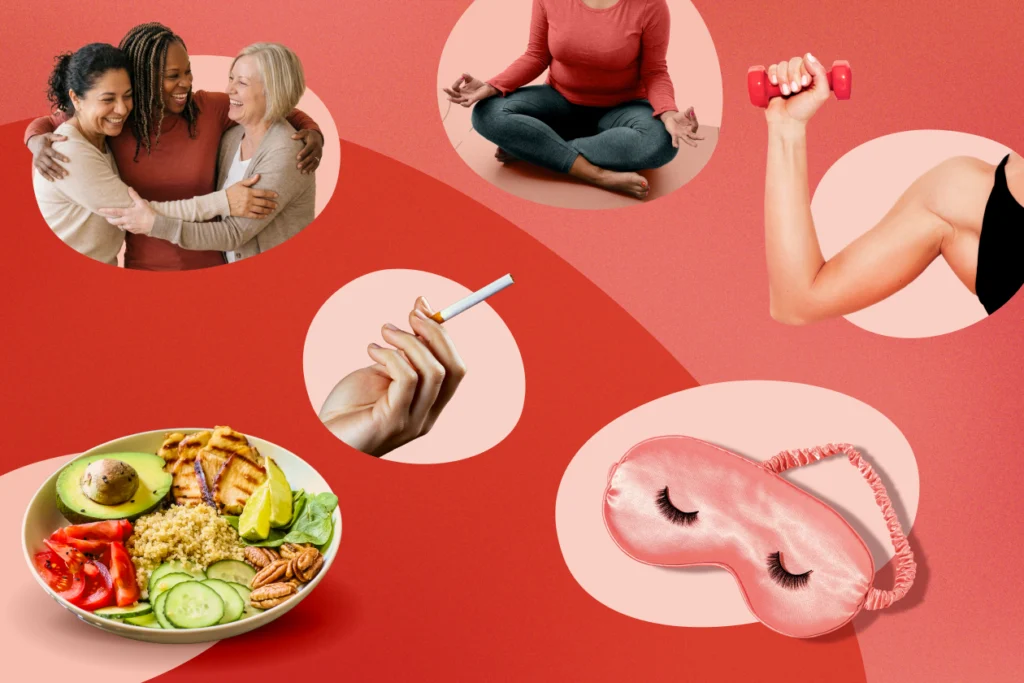
Here’s what almost nobody tells you: the difference between living a long life and living a long, healthy one isn’t found in any single fix. Researchers have a name for that difference. It’s called the health gap, the gap between how long you live and how many of those years you get to spend without cardiovascular disease, cancer, diabetes, or a neurodegenerative disease quietly reshaping what your day-to-day looks like.1 Medication and screenings are a real layer on top, catching and treating what shows up. But it’s six ordinary habits, most of which you already have the ingredients for, that do the heavy lifting underneath: nutrition, movement, sleep, mental well-being, avoiding risky behaviours, and community. These are the six pillars of lifestyle medicine, and they’re what moves the needle on how many of your years are good ones.
None of this replaces your doctor or your prescriptions. Lifestyle medicine works alongside medical care, filling in the piece that rarely comes up in a fifteen-minute appointment because there’s never enough time to get into it.
Pillar 1: What you eat still matters. How you eat is the part that gets ignored
Food quality and food behaviour aren’t competing priorities, they’re both doing real work, and most nutrition advice only covers one of them.
Most of us already know the broad strokes on quality: eat less processed food, more protein and fibre, fewer drive-through dinners. That part hasn’t changed much over the years, even as everything else about nutrition advice seems to. What tends to get skipped is everything around the food. Are you eating standing up at the counter, or in front of a tv screen at 9 p.m.? Do you sit down with anyone, ever? Do you stop eating a few hours before bed, or is the last bite a handful of crackers on your way up the stairs? Get the food itself right and ignore all of that, and you’re still leaving a real piece of the benefit on the table.
The Mediterranean diet keeps coming out on top in longevity research, and it’s not only because of the olive oil and the fish. It’s the whole culture wrapped around it: cooking, sharing meals, eating what’s local and in season, taking the time to sit down at all. That’s harder to replicate on a Tuesday that includes a school pickup and a work deadline, but the underlying idea remains: food prep doesn’t have to be a chore squeezed in before you collapse on your sofa with a glass of pinot. Fifteen minutes peeling carrots with music on can be its own mindful break… but keep your eyes open while using a knife 😉
A few numbers are worth having on hand rather than a general sense of “eat better.” Aim for roughly 25 to 30 grams of protein at each meal, not just at dinner, since that’s closer to what your body needs to work with for muscle repair as you age, well above what most of us grew up treating as a normal serving.2 Fibre works the same way: most people are eating roughly half of what is recommended to prevent issues with cholesterol and blood sugar, so 30 grams a day, from green leafy vegetables, beans, lentils, steel cut oats, and berries, is a target worth building toward.3 And variety counts for more than any single ingredient does. People who eat a large variety of different plant foods in a week tend to have a measurably more diverse gut microbiome than people eating the same food week after week. And fermented foods like yogurt, kefir, or sauerkraut are one of the easiest ways to support your gut.4
Aim for roughly 80 percent of your meals to be the kind you’d feel good telling your care provider about, and let the other 20 percent be dinner out with friends without the guilt trip. Protein earlier in the day helps steady the hormones that manage appetite and energy, which matters more as you get older. And if you’re someone who gets hangry in the car, willpower rarely wins that fight. Real snacks within arm’s reach do, so a rough afternoon doesn’t turn into a drive-through decision made under duress.
A quick note on intermittent fasting: there’s no universal answer here. If you’re managing insulin resistance, a shorter eating window might help. If you’re already low on energy or trying to build muscle, it might work against you. The only way to know is to try it and pay attention to how you feel, not to what worked for whoever posted about it online.
Pillar 2: Movement is bigger than your step count
Steps are one visible piece of the movement pillar, but the muscle you’re building, or losing, is doing just as much work for your long-term health.
Steps get most of the attention because they’re the easiest thing to measure, and the famous number attached to them has a strange origin story. Ten thousand steps comes from a 1960s Japanese marketing campaign for a pedometer literally named “10,000-step meter.”5 It was never based on research. It was just catchy. And somehow, it stuck around for six decades.
The actual research tells a more forgiving story. A 2025 analysis in The Lancet Public Health pooled 57 studies on step count and health outcomes, and the curve isn’t a straight line.6 The steepest drop in all-cause mortality risk, roughly 47 percent lower, happens between 2,000 and 7,000 steps. After that, the curve flattens. More steps still help. But the dramatic returns are already banked by 7,000. So if you’re at 3,000 a day, aim for 5,000 next, then 7,000… not 10,000 in one leap. Small changes are more sustainable.
Steps only measure how much you’re moving. They say nothing about what that movement is doing to your muscles, and that’s the half of the pillar that tends to get skipped. Muscle mass becomes harder to build and easier to lose as you age, especially through the menopause transition, and it isn’t just about strength for its own sake. It directly affects how your body manages weight and blood sugar, how well your metabolism runs at rest, and how steady you are on your feet later in life. A walk, however long, doesn’t build or protect that muscle. Resistance training does: pushing, pulling, carrying, or lifting something heavier than your body is used to, a couple of times a week.
The two work together rather than competing for your time. Small movements spread across the day (a 10-minute walk after a meal, taking the stairs, shifting your weight at a standing desk) is what keeps you out of the sedentary stretches that undo a lot of the benefit, even for people who exercise hard once a day. Strength work, even just squats or push-ups worked into a coffee break, builds the muscle that keeps carrying you once the walk is over. Neither one replaces the other. A single long, intense workout followed by a sedentary rest of the day doesn’t offer the same protection. Movement, of both kinds, spread more evenly across your hours, is the key.
Pillar 3: Sleep is the one that makes or breaks the other five
If sleep is off, nothing else in your routine can fully compensate for it.
North America has quietly normalized sleeping about two hours less than we need, and it shows up everywhere: higher inflammation, weaker immunity, worse blood sugar control, and a documented link to weight gain. A researcher at Columbia University, Marie-Pierre St-Onge, led the American Heart Association’s own statement connecting poor sleep to obesity and metabolic health, and the pattern holds regardless of how carefully someone eats or exercises.7 Skimp on sleep consistently, and the other habits are working against a headwind.
The target most research points to is seven to nine hours, on a regular basis, not just occasionally.8 Sleep follows what’s called a J-curve: both under six hours and over ten hours, night after night, are linked to higher risk of chronic disease.9 Sleeping pills can help in the short term, but they change the structure of sleep itself, and it’s deep sleep specifically that handles the overnight repair work.
A few mechanics worth knowing
- Roughly half of people are slow metabolizers of caffeine, meaning it can take over 12 hours to clear their system, so that 2 p.m. coffee might still be blocking the sleep pressure your body needs at 10 p.m.
- Melatonin, the hormone that helps trigger sleep, responds to light, so how much daylight you get (and when) matters more than most people assume.
- Everyone also has a natural chronotype, whether you’re an early riser or a night owl, and working against it for years carries its own health risk. If your work schedule has been out of step with that rhythm for a long time, midlife is a fair moment to ask whether it’s still worth the fight.
- Cut evening blue light where you can, most phones and laptops already have a night mode built in, and blue-light glasses are a low-effort option for whatever screen time is unavoidable.
- Give your last meal a few hours of runway before you lie down, and go easy on evening alcohol: it may help you fall asleep faster, but it fragments the sleep that follows.
- If evening is your only window to exercise, save anything intense for earlier in the day, and let the evening version be stretching or slow breathing that works with your body’s wind-down instead of against it.
Does hormone therapy help with sleep during perimenopause? For some women, yes, it can meaningfully improve sleep disrupted by hormonal shifts. But the daily habits above matter regardless of where you land on that decision. A good night’s sleep is mostly decided in the 16 hours before you lie down, long before the bedtime routine even starts.
Pillar 4: Mental well-being isn’t the absence of stress. It’s knowing which kind you’re dealing with
Chronic stress is what quietly undermines the other pillars, sleep especially, and the two feed each other in both directions.
Some stress is useful. It’s what gets you out of the way of actual danger. The problem isn’t stress showing up, it’s stress that never leaves, the kind that keeps your nervous system on alert long after the meeting ended or the kids are asleep. Poor sleep raises the same stress hormones that chronic stress runs on, and chronic stress makes it harder to fall and stay asleep, so the two habits above wear on each other from both sides. That state is called allostatic load, and it has a very specific tell: if you get sick every single time you finally slow down on vacation, that’s not bad luck. More often, it’s your body finally getting the signal that it’s safe to stop holding it together.
Chronic stress doesn’t stay in its lane. It disrupts sleep, drives cravings, kills motivation to move, and it does all of this quietly enough that most people don’t connect the dots. You can’t fix it by declaring a stress-free week, because that’s not how the nervous system works. What helps tends to be smaller and more physical than people expect: two or three minutes of contact with the ground, telling yourself out loud that you’re safe right now, eating a meal without a screen in front of you, or writing down the running list in your head so your brain stops treating it as something it has to hold onto.
None of this eliminates stress permanently, and it isn’t meant to. What it does is give your nervous system enough small, repeated proof that you’re not in real danger, so it can come back down off alert.
Pillar 5: Not every risky behaviour looks risky
The habit worth examining isn’t always the obvious one. Sometimes it’s the one everyone compliments you on.
Alcohol guidance has shifted meaningfully. For years, up to 10 drinks a week was considered a reasonable ceiling for women. Current Canadian guidance points to something closer to three.10 That doesn’t mean giving it up, it means noticing whether that third glass is something you want or something you’re having because everyone around the table is still pouring. Something as simple as ordering a glass of water before the wine can turn that next glass into a choice instead of a reflex. Crossing that line regularly isn’t just a sleep issue, either: three or more drinks a week is linked to a measurable increase in breast cancer risk, on top of whatever it’s doing to how you sleep and recover.11
But the less obvious risky behaviours are the ones that look entirely virtuous. Training through pain, skipping recovery, and treating a rest day like a failure is one version. A supplement stack that started with a multivitamin and quietly grew to a dozen bottles is another. So is an approach to “clean eating,” or a fasting window, so rigid that a dinner party feels like a failure instead of a normal night out with friends. None of these look risky from the outside, which is exactly what makes them easy to miss from the inside. Cigarettes and an ultra-processed diet belong in the same conversation for the same reason: the cumulative cost to cancer risk and cardiovascular health is real.
Pillar 6: Loneliness is a measurable health risk, not just a feeling
Chronic isolation carries a health impact comparable to smoking.
Researchers who study longevity make that comparison directly, and it isn’t a figure of speech: one widely cited analysis found that weak social connection carries a mortality risk on par with smoking up to 15 cigarettes a day.12 The places in the world with the highest concentrations of people living past 100 share a common trait: strong, consistent social connection. Not a large social circle necessarily, just real, regular contact.
Life has a way of quietly deprioritizing this. The friend who texted last week is still unanswered, and it’s rarely because you don’t care about her. But everything else claimed the calendar first. Rebuilding it doesn’t require a grand gesture. It can look like a recurring, non-negotiable block of time for the people who matter to you, a habit of asking a coworker something other than a status update, and simply reaching back out even when it feels a little awkward after months of silence. It gets less awkward the second time, and most people are relieved someone made the first move.
What to focus on, by decade
Your priorities shift as your body does, and knowing what matters most at each stage saves you from spreading effort too thin.
In your 20s and 30s
This is when you build the muscle and bone density you’ll draw on for the rest of your life. Calcium, vitamin D (especially if you’re somewhere with long, dark winters 🇨🇦), and higher-impact activity like running or dancing all support bone density in a way that’s harder to build later. This decade is also when it’s worth learning your own menstrual cycle and baseline symptoms, so you have something to compare against later.
In your 40s
Muscle mass becomes a priority in a different way. As estrogen declines, it gets progressively harder to build or even maintain muscle, and body composition, not the number on the scale, becomes the more useful thing to track. This is also the decade to start distinguishing “am I sleeping badly because of hormones” from “am I sleeping badly because I’m anxious,” because the answer changes what helps.
In your 50s and beyond
The average age of menopause is 51 to 52, and this is where self-compassion earns a real place in the list, alongside recovery and balance work. Falls are one of the leading causes of serious injury and hospitalization later in life, and balance training now is what prevents that later.
Where to start, if you’re overwhelmed
If you take one thing from all six pillars, take this: fix sleep first. Poor sleep undercuts the other five before you even get out of bed. It raises the hormone that drives appetite. It drops the one that signals fullness. It leaves you with less patience for a hard conversation and less energy for a walk, a workout, or a friend’s dinner you’d otherwise look forward to.
You don’t need to overhaul six areas of your life this month. Pick the pillar that’s most broken right now, make one small change. Let it sit next to a habit you already have on autopilot like brushing your teeth, making coffee, locking the door behind you, until it becomes just as automatic. It has nothing to do with motivation and everything to do with repetition.
If you want support figuring out where your own health gap is, the Coral care team can support you and provide a personalized care plan tailored to your life stage and goals. Schedule a call with a care coordinator to find out if Coral is the right solution for you.
Disclaimer: The information provided here is for informational purposes only. It is not intended as medical advice. Always consult with your doctor or healthcare provider to determine what is best for your individual health needs.
While we use the word “women” for simplicity, we recognize that menopause and perimenopause can affect people of many gender identities. Our goal is to support everyone who experiences these changes.
Sources:
- Garmany A, et al. Healthspan-lifespan gap differs in magnitude and disease contribution across world regions. Communications Medicine (Nature), 2025. nature.com/articles/s43856-025-01111 ↩︎
- Bauer J, et al. Evidence-Based Recommendations for Optimal Dietary Protein Intake in Older People: A Position Paper From the PROT-AGE Study Group. Journal of the American Medical Directors Association, 2013. pubmed.ncbi.nlm.nih.gov/23867520 ↩︎
- Reynolds A, et al. Carbohydrate quality and human health: a series of systematic reviews and meta-analyses. The Lancet, 2019. pubmed.ncbi.nlm.nih.gov/30638909 ↩︎
- McDonald D, et al. American Gut: an Open Platform for Citizen Science Microbiome Research. mSystems, 2018. journals.asm.org/doi/10.1128/msystems.00031-18 ↩︎
- Where did 10,000 steps a day come from? News-Medical.net. news-medical.net/health/Where-did-10000-steps-a-day-come-from.aspx ↩︎
- Ding D, et al. Daily steps and health outcomes in adults: a systematic review and dose-response meta-analysis. The Lancet Public Health, 2025. thelancet.com/journals/lanpub/article/PIIS2468-2667(25)00164-1 ↩︎
- St-Onge MP, et al. Sleep Duration and Quality: Impact on Lifestyle Behaviors and Cardiometabolic Health: A Scientific Statement From the American Heart Association. Circulation, 2016. pubmed.ncbi.nlm.nih.gov/27647451 ↩︎
- Hirshkowitz M, et al. National Sleep Foundation’s sleep time duration recommendations: methodology and results summary. Sleep Health, 2015. sleephealthjournal.org/article/s2352-7218(15)00015-7 ↩︎
- Yin J, et al. Relationship of Sleep Duration With All-Cause Mortality and Cardiovascular Events: A Systematic Review and Dose-Response Meta-Analysis of Prospective Cohort Studies. Journal of the American Heart Association, 2017. ahajournals.org/doi/10.1161/JAHA.117.005947 ↩︎
- Canadian Centre on Substance Use and Addiction. Canada’s Guidance on Alcohol and Health, 2023. ccsa.ca/canadas-guidance-alcohol-and-health ↩︎
- Ibid. ↩︎
- Holt-Lunstad J, et al. Loneliness and Social Isolation as Risk Factors for Mortality: A Meta-Analytic Review. Perspectives on Psychological Science, 2015. local.psy.miami.edu/faculty/dmessinger/c_c/rsrcs/rdgs/emot/PerspectivesonPsychologicalScience-2015-Holt-Lunstad-227-37.pdf ↩︎