
We know what midlife really looks like, because we see women go through it every day. The symptoms are only part of it. There’s also divorce, empty nests, a sex life that has gone quiet, goals that never came to be, aging parents, and grief for what didn’t happen.
Midlife is not just hot flashes, and we feel it’s our responsibility to let the world see that. Caring for women means more than helping them feel like themselves again. It means helping them feel heard, seen and understood. So we opened the phone lines and recorded women brave enough to share their story.
Those stories give women a place to get things off their chest. They help other women feel less alone, and they help everyone else, who may have no idea what’s going on, finally understand. Women’s health has been silent for too long. We’ve captured the voices, and it’s time to amplify them.
“The thing I had to figure out on my own? Everything!” a woman said, into our phone at our booth in Toronto.
Over two days in October, we invited women to say the things they had kept to themselves. About 80 of them did, on camera. And now it’s your turn.
We had asked for confessions, and we got everything. Some were loud stories about life changing moments, like the woman who lost a career because no one connected the changes she was experiencing to menopause. Others were quieter, behind-the-scenes stories: a doctor who said it was too early for perimenopause, or a personal decision to stop apologizing for needing a rest.
You can call 1-343-MIDLIFE and leave your story. It’s anonymous, voice only.
Why we created a hotline for your midlife confessions
Too much of midlife happens in silence. We wanted to give women a place to say it out loud, and give everyone else a chance to hear it.
Women tell us the same thing again and again: they feel like nobody is listening. Their symptoms get brushed off, and the bigger things, like a marriage ending, a career stalling, or parents who suddenly need care, rarely come up at all. So most women work through it alone, assuming they’re the only one.
Our mission is to empower women in midlife, and we believe that starts with breaking that silence. When one woman says what she’s going through, two things happen. She gets to feel heard, sometimes for the first time. And another woman, hearing her, realizes she isn’t alone. The more these voices are shared, the harder it gets for anyone to overlook what midlife really involves.
That’s why we chose confessions. They ask very little of you. You don’t need to explain your whole history or have a question ready. You say one true thing, and that’s enough. We chose a phone because a voice holds emotion that a written note can’t, and hearing another woman say it out loud can make you feel seen in a way reading it never will.
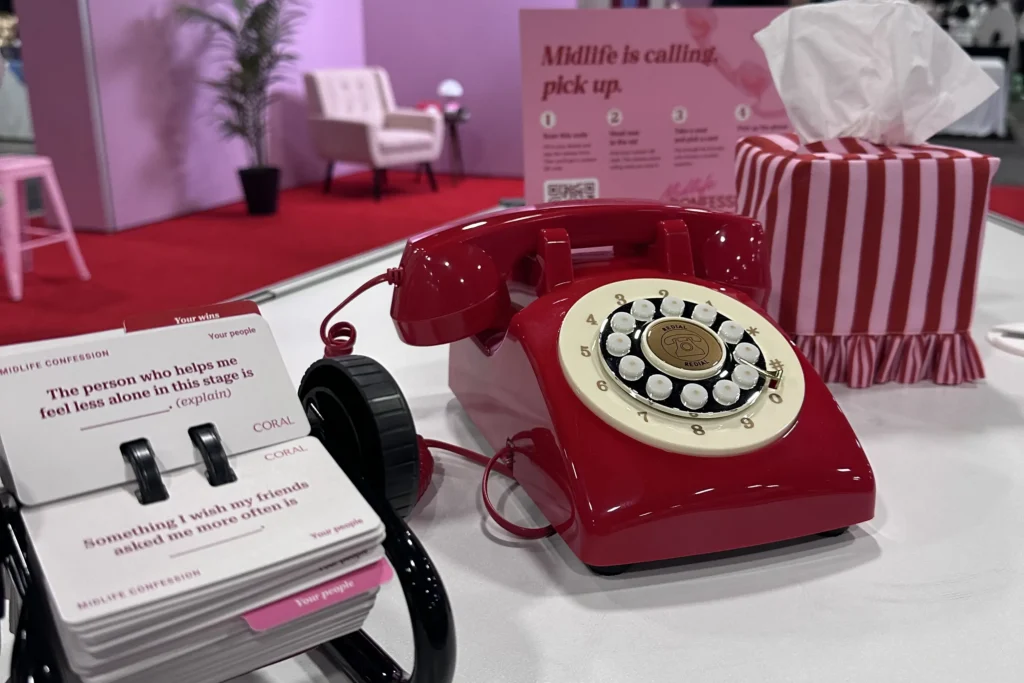
We first brought the line to the National Menopause Show in Toronto, where women picked a prompt card, lifted the receiver, and recorded their confessions on camera. You can watch them on Instagram, Facebook, YouTube, or TikTok. Now the line is open to everyone at 1-343-MIDLIFE. It’s voice only, so it stays anonymous. The stories below come from those first two days at the show.
What women are saying
Four themes kept coming back across both days: nobody warned them, they had to push for care, they learned to say no, and other women got them through.
This isn’t a study. It’s our observations of 80 confessions from women who chose to walk up to our booth. These are personal stories, not a count of all women’s experiences.
“Nobody told us”
This was the most common thread. Women described symptoms they didn’t see coming, a stage that started earlier than they were told, and working it all out by themselves.
Going in informed, because you have to
Several of them said they were dismissed, or told it was too early for perimenopause, and this is what one of them wanted other women to take from it:
“I wish throughout my life that we had doctors that knew about menopause, because it’s a long journey. It’s really half of our life… Be your own advocate.”
Saying no, and not needing permission
This was the biggest upbeat theme, in roughly 15 to 18 clips. It covers saying no, letting go of perfection, and resting without asking anyone.
Finding your people
Women named community as the thing that got them through.
“…going through it is much easier if you have your meno posse by your side to laugh with, cry with, scream with, share memes with.”
The symptom we didn’t expect to hear most
Brain fog and memory loss came up more often than hot flashes, and it was the symptom guests most often said nobody had warned them about.
Brain fog or memory loss showed up in about six clips, and hot flashes and night sweats in about four. It’s a small gap in a small sample, so we’re reading it as a hint and nothing more.
What made it stick was how women described it: as something with consequences. One woman told us she lost a 20-year career because no one around her connected the changes in her thinking to menopause.
“No one had ever told me that that was going to be a thing… I want women to know to expect it.
If you’ve ever walked into a room and forgotten why, or lost a word halfway through a sentence at work, and wondered whether it could be connected to menopause, the women who raised it wondered too. Several said no one had told them to expect it, and that they wish someone had.
Normal, but not meant to be braved alone
Almost every confession landed on the same message: menopause is a normal transition, and going through it unprepared and on your own is the part that isn’t.
One woman put it simply:
“Menopause isn’t a disease. It’s a natural and normal transition of life.”
The symptoms are ordinary. What women kept naming was everything around them. First came the missing warning, then the appointment that ends in “it’s too early,” and then working it out alone.
The way through, in their words, came down to three things: know what’s coming, speak up for yourself, and keep your people close. Saying yours out loud, even to a phone line, is a small way to do the last two.
How to leave yours
Call 1-343-MIDLIFE, press 1 to say whatever’s on your mind or 2 to 9 for a prompt, and leave a confession of about a minute. You don’t have to give your name.
You’ll hear a short welcome first, and it says why we’re asking: your story will help other women feel seen. By leaving a message, you agree that we may share your anonymous recording online. Our team listens to every confession before anything is published, and if we share yours on social media, we’ll text you at the number you called from.
It doesn’t have to be dramatic. Press 1 to simply get things off your chest, or pick a number from 2 to 9 for one of eight prompts, like these:
- What’s something about menopause nobody prepared you for?
- If you could call 1989 you, what would you tell her?
- Share some good news about midlife.
Still hesitating? Say the first one that comes to mind. Nobody is grading it.
It’s your turn
If you’ve ever worked something out alone that someone could have told you, that’s worth sharing.
Call 1-343-MIDLIFE and say the thing you haven’t said yet. It takes about a minute, and you might feel lighter. Another woman may hear it and realize she isn’t the only one.
Not ready to call? Watch a few of the confessions on Instagram, Facebook, YouTube, or TikTok and see if it resonates with you. Or send this to one friend who’d get it. She might have a confession of her own or she might be waiting for a sign to go first.
Disclaimer: The information provided here is for informational purposes only. It is not intended as medical advice. Always consult with your doctor or healthcare provider to determine what is best for your individual health needs.
While we use the word “women” for simplicity, we recognize that menopause and perimenopause can affect people of many gender identities. Our goal is to support everyone who experiences these changes.