
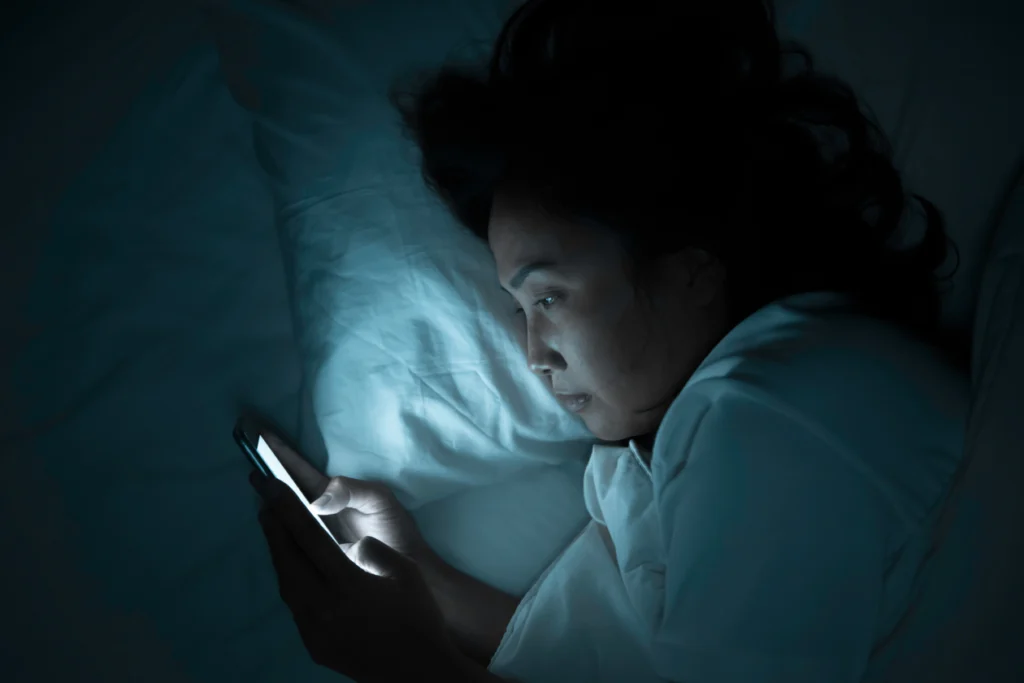
It’s 3:14am. You didn’t drink coffee after noon. You did the stretching, the magnesium, the whole routine. And you are still staring at the ceiling, wide awake, brain unhelpfully replaying a conversation from 2019.
Perimenopause insomnia is a documented shift in how your body sleeps, driven by hormonal changes researchers can measure directly, not something more melatonin gummies will fix on their own. Here’s what’s happening, what the research says helps, and what to do if it’s gone on long enough that you need more than a tight bedtime routine.
Why does menopause disrupt sleep?
Estrogen and progesterone swing unpredictably before settling lower, and both hormones had sleep-related jobs your brain is now adjusting to do without.
Estrogen’s role is more about keeping sleep steady through the night and helping regulate your body’s internal temperature, which matters a lot once you get to hot flashes (more on that next). Progesterone plays a role too. Your body converts some of it into a metabolite called allopregnanolone. Allopregnanolone is what acts on the brain’s calming GABA-A system (the same one targeted by anti-anxiety medications) to help you drift off. Not everyone converts progesterone into allopregnanolone at the same rate, so this effect isn’t identical from one woman to the next.1 As progesterone levels fluctuate and gradually drop through perimenopause, that effect gets less reliable.
Here’s the part that surprised the researchers themselves. When scientists have hooked women up to sleep labs and measured what’s happening, total sleep time and deep sleep haven’t consistently gotten worse during the menopause transition; in some studies they stayed the same or even improved. What did change, in the largest study of its kind, was the brain’s electrical activity overnight. Women transitioning through menopause showed more of a “high alert” brainwave pattern, the kind normally seen in people with chronic insomnia. And it showed up whether or not they were having hot flashes that night.2
In plain terms: your brain can be in a lighter, more easily disturbed state at night, even on nights the machines say you technically “slept fine.” That mismatch, feeling awful while the numbers look fine, is a big part of why perimenopause insomnia is so hard to explain to anyone who hasn’t experienced it.
Hot flashes at night: the main culprit
Your body has an internal thermostat, and menopause knocks its setting out of whack, so a small internal temperature blip can trigger a full-blown heat surge that jolts you awake.
A hot flash isn’t really about being too warm. It’s your brain’s temperature-control centre overreacting to a tiny shift in body heat that it would normally ignore. As estrogen fluctuates and drops, this control centre narrows its comfort zone dramatically. A half-degree change it would normally shrug off instead sets off the full cooling response. Your blood vessels widen. You flush. You sweat. You wake up.
This is common, and not in a hand-wavy way: in one of the largest long-term studies tracking women through this transition, night sweats specifically went from affecting about 1 in 5 women years before their final period to roughly 2 in 5 women in the year after it.3 Hot flashes overall climbed even higher, to about 3 in 5 women in that same window.
One thing researchers noticed almost by accident: these symptoms have a season. In that same study, hot flashes, night sweats, and trouble sleeping all peaked around midsummer and dipped in January; night sweats specifically were about 50% more likely at their peak than their low point.4 Nobody’s fully explained why yet. If your worst stretch always seems to be July, that’s likely why.
Perimenopause insomnia vs. general insomnia: what is different
It’s rarely trouble falling asleep. It’s trouble staying asleep, waking up in the middle of the night whether or not a hot flash woke you.
Ordinary insomnia often shows up as a racing mind at bedtime. Perimenopause insomnia tends to look different: you fall asleep just fine, then surface a few hours in and can’t get back down. Roughly 1 in 4 perimenopausal women meet the clinical criteria for insomnia. The more hot flashes they have, the more likely they are to qualify.5 Longer-running data backs this up: difficulty staying asleep is consistently the most common complaint through the transition, more so than trouble falling asleep or waking too early.6
Is perimenopause insomnia just “regular” insomnia with extra steps?
Not entirely. Research comparing insomnia in menopausal vs. premenopausal women found that even when both groups described their sleep problems the same way, the menopausal group’s sleep labs showed measurably more time spent lying awake overnight and less of the night spent asleep.7 The complaint sounds the same. What’s happening in the body is measurably more disrupted. Part of the reason why comes down to a mechanism most menopause content skips entirely: your stress hormones.
Cortisol and sleep: why stress makes everything worse
Cortisol and stress-hormone dysregulation are a real, measurable driver of middle-of-the-night waking during perimenopause, and this holds up even in women without hot flashes.
Cortisol isn’t just “the stress hormone” in a vague sense. It runs on its own daily rhythm: normally low and quiet overnight, then rising sharply in the morning to help you wake up and get moving. Chronic insomnia in general is understood as a state of round-the-clock over-alertness. People with insomnia tend to run measurably higher cortisol than good sleepers.8
Menopause adds its own layer on top of that. In one study of perimenopausal women, more nighttime awakenings tracked with the hormone shifts of the transition itself, falling estrogen and rising FSH, even after accounting for hot flashes and mood symptoms separately.9
Cortisol plays into this too. Normally it stays quiet overnight, released in small, spaced-out pulses. When those pulses are disrupted or poorly timed, they’re thought to be able to trigger an awakening and make it harder to fall back asleep.10 And the relationship runs both directions. In a lab study of perimenopausal women, an approaching stressor raised cortisol and heart rate before bed. Among the women with insomnia specifically, their nervous systems failed to properly settle back down over the course of the night.11
A separate experiment showed how this loop can feed itself. Researchers deliberately fragmented participants’ sleep, then measured the hormonal fallout: bedtime cortisol rose by 27%, and the next morning’s cortisol rise, the jump that’s supposed to help you wake up, was blunted by 57%.12 Losing estrogen lowered bedtime cortisol on its own, independent of the sleep disruption itself. Poor sleep raises stress hormones. Disrupted stress hormones make sleep worse.
How poor sleep leads to fatigue during menopause
Broken sleep and rough moods feed each other. You sleep badly, which makes you more reactive and drained the next day, which makes it harder to wind down the next night.
This isn’t a stretch: researchers tracking the same women through the menopause transition found psychological distress, the kind that shows up as low mood, irritability, or anxiety, affects roughly a quarter to nearly a third of women at different points in the transition.13 Disrupted sleep is one of the clearest threads tying hormone changes to that distress. Poor sleep doesn’t just make you tired; it makes everything else (patience, focus, mood regulation) harder to access the next day, which then makes falling and staying asleep that night even harder. It’s a loop, not a one-off bad night.
Evidence-based sleep strategies for menopause
Before the specifics, it’s worth sorting out where to start, especially if you never had trouble sleeping before perimenopause. If your sleep problems show up right alongside your hot flashes and track closely with them, worse on rough hot-flash nights, better when they ease up, treating the hot flashes directly (covered in the hormone therapy section below) is often the more direct first move.
One of the most rigorously studied fixes for that hyperarousal pattern isn’t a supplement or a bedtime ritual. It’s a structured therapy called CBT-I, built specifically to treat the “high alert” pattern covered above.
CBT-I stands for cognitive behavioural therapy for insomnia. It’s not talk therapy about your feelings about sleep, and it’s not generic sleep advice repackaged. It’s a practical, short-term program that retrains your sleep habits: temporarily tightening the time you spend in bed so your body relearns how to fall asleep quickly, breaking the habit of lying awake in bed so your brain stops associating your bed with wakefulness, and working through the anxious thoughts that show up the moment a hot flash or a hormone-driven awakening jolts you back up.14
What about basic sleep hygiene, the “no screens before bed” advice?
It’s worth doing, but on its own it’s weak medicine. In a trial that tested sleep hygiene education by itself against real CBT-I, the sleep-hygiene-only group barely improved and the gains didn’t last, while the CBT-I group’s results held.15 Good habits help you make the most of a CBT-I program. They’re not a substitute for one.
What about progesterone specifically?
It’s a legitimate, evidence-backed option worth knowing about, and separate from broader hormone therapy. A Canadian trial followed 189 perimenopausal women across the country for three months. Women taking oral micronized progesterone (300mg nightly) reported significantly fewer night sweats and better sleep quality than those on placebo.16 The trial’s main measure, a combined day-and-night symptom score, didn’t show a significant difference between groups. The sleep and night sweat improvements came from a secondary measure where women rated the changes they noticed themselves. A separate meta-analysis pooling ten randomized trials also found micronized progesterone helped people fall asleep faster than a placebo.17 Since progesterone is a prescription-only option, it’s worth talking with your care provider about whether it’s a good fit for you.
Supplements are a mixed bag, and the quality of evidence varies a lot from one to the next. A pooled analysis of over 500 women across four separate trials found omega-3 supplements made no measurable difference to insomnia symptoms.18 We didn’t find solid trial evidence for melatonin specifically for menopause insomnia either. One herbal option does stand out: ashwagandha. A meta-analysis pooling five trials and 400 people found a real, measurable improvement in sleep, with the strongest effects in people already diagnosed with insomnia.19 None of those trials were done specifically in perimenopausal or menopausal women, though, so the results don’t transfer over perfectly.That doesn’t mean other supplements can’t help you personally, just that the research isn’t there yet to promise it for most of them. If you’re curious about trying something, your care team can help you weigh the evidence against what’s going on with you and check for interactions with anything else you’re taking.
As for cooling (a fan, breathable sheets, a cooler bedroom), this hasn’t been tested the way CBT-I has, so we can’t call it “proven.” But it’s low-cost and low-risk. It also lines up with everything we know about how hot flashes trigger waking. Most sleep clinicians still recommend it as a sensible first move.
Does HRT improve sleep during menopause?
For many women, especially when hot flashes are the main disruptor, treating the hormonal cause directly is the most targeted option.
Hormone therapy is designed to reduce hot flashes, and fewer hot flashes generally means fewer of the awakenings they cause. In one research program comparing several menopause treatments side by side, estrogen therapy was linked to better overall sleep quality than a placebo, and a different, non-hormonal prescription option showed a stronger effect on insomnia symptoms specifically in that same research.20 Care providers weigh this differently depending on what’s driving a given patient’s sleep problems, which is exactly why this isn’t a one-size-fits-all answer.
As covered above, there’s real trial evidence that progesterone specifically helps women fall asleep faster.21 Put together, hormone therapy, and progesterone in particular, is a legitimate, well-used option for perimenopause sleep problems, not a fallback to CBT-I. What helps you will depend on what’s driving your particular sleep problem, your health history, and what you’re comfortable with. That’s exactly the kind of thing your care team can walk you through.
When to seek medical help for menopause insomnia
A few signs mean it’s time to loop in a professional rather than keep troubleshooting solo: loud snoring or gasping at night, restless or crawling sensations in your legs at bedtime, insomnia that’s stuck around for more than a few months, or sleep problems tangled up with low mood or anxiety.
Sleep apnea becomes a lot more common after menopause. It needs its own treatment, typically a breathing device rather than hormones, because hormone therapy’s effect on it is inconsistent.22 Restless legs syndrome often needs a different approach entirely, sometimes tied to iron levels, and doesn’t reliably respond to hormone therapy either.23 And if what’s keeping you up is tangled up with anxiety or a persistently low mood, that’s worth naming directly rather than filing it all under “bad sleep.”
If any of that sounds like your night, your Coral care team can help you figure out what’s driving it instead of guessing at one symptom at a time. Book a call with a Coral care coordinator to talk through what’s going on and whether Coral is the right next step for you.
Disclaimer: The information provided here is for informational purposes only. It is not intended as medical advice. Always consult with your doctor or healthcare provider to determine what is best for your individual health needs.
While we use the word “women” for simplicity, we recognize that menopause and perimenopause can affect people of many gender identities. Our goal is to support everyone who experiences these changes.
Sources:
- Nolan BJ, Liang B, Cheung AS. Efficacy of micronized progesterone for sleep: a systematic review and meta-analysis of randomized controlled trial data. J Clin Endocrinol Metab. 2021;106(4):942-951. doi:10.1210/clinem/dgaa873 ↩︎
- Matthews KA, Lee L, Kravitz HM, Joffe H, Neal-Perry G, Swanson LM, Evans MA, Hall MH. Influence of the menopausal transition on polysomnographic sleep characteristics: a longitudinal analysis. Sleep. 2021;44:zsab139. doi:10.1093/sleep/zsab139 ↩︎
- Harlow SD, Elliott MR, Bondarenko I, Thurston RC, Jackson EA. Monthly variation of hot flashes, night sweats and trouble sleeping: effect of season and proximity to the final menstrual period (FMP) in the SWAN Menstrual Calendar substudy. Menopause. 2020;27(1):5-13. doi:10.1097/GME.0000000000001420 ↩︎
- Ibid. ↩︎
- Baker FC, Lampio L, Saaresranta T, Polo-Kantola P. Sleep and sleep disorders in the menopausal transition. Sleep Med Clin. 2018;13(3):443-456. doi:10.1016/j.jsmc.2018.04.011 ↩︎
- Ibid. ↩︎
- Ibid. ↩︎
- Dressle RJ, Feige B, Spiegelhalder K, et al. HPA axis activity in patients with chronic insomnia: a systematic review and meta-analysis of case-control studies. Sleep Med Rev. 2022;62:101588. doi:10.1016/j.smrv.2022.101588 ↩︎
- Coborn J, de Wit A, Crawford S, et al. Disruption of sleep continuity during the perimenopause: associations with female reproductive hormone profiles. J Clin Endocrinol Metab. 2022;107(10):e4144-e4153. doi:10.1210/clinem/dgac447 ↩︎
- Vargas I, Vgontzas AN, Abelson JL, et al. Altered ultradian cortisol rhythmicity as a potential neurobiologic substrate for chronic insomnia. Sleep Med Rev. 2018;41:234-243. doi:10.1016/j.smrv.2018.03.003 ↩︎
- de Zambotti M, Sugarbaker D, Trinder J, Colrain IM, Baker FC. Acute stress alters autonomic modulation during sleep in women approaching menopause. Psychoneuroendocrinology. 2016;66:1-10. doi:10.1016/j.psyneuen.2015.12.017 ↩︎
- Cohn AY, Grant LK, Nathan MD, et al. Effects of sleep fragmentation and estradiol decline on cortisol in a human experimental model of menopause. J Clin Endocrinol Metab. 2023;108(11):e1347-e1357. doi:10.1210/clinem/dgad285 ↩︎
- Kravitz HM, Joffe H. Sleep during the perimenopause: a SWAN story. Obstet Gynecol Clin North Am. 2011;38(3):567-586. doi:10.1016/j.ogc.2011.06.002 ↩︎
- Baker FC. (5) ↩︎
- Ntikoudi A, Owens DA, Spyrou A, Evangelou E, Vlachou E. The effectiveness of cognitive behavioral therapy on insomnia severity among menopausal women: a scoping review. Life. 2024;14(11):1405. doi:10.3390/life14111405 ↩︎
- Nolan BJ (1) ↩︎
- Prior JC, Cameron A, Fung M, et al. Oral micronized progesterone for perimenopausal night sweats and hot flushes: a Phase III Canada-wide randomized placebo-controlled 4-month trial. Sci Rep. 2023;13:9082. doi:10.1038/s41598-023-35826-w ↩︎
- Reed SD, LaCroix AZ, Anderson GL, et al. Lights on MsFLASH: a review of contributions. Menopause. 2020;27(4):473-484. doi:10.1097/GME.0000000000001461 ↩︎
- Cheah KL, Norhayati MN, Husniati Yaacob L, Abdul Rahman R. Effect of Ashwagandha (Withania somnifera) extract on sleep: a systematic review and meta-analysis. PLoS One. 2021;16(9):e0257843. doi:10.1371/journal.pone.0257843 ↩︎
- Reed SD (18) ↩︎
- Nolan BJ (1) ↩︎
- Baker FC (5) ↩︎
- Ibid. ↩︎