Perimenopause (the transitional phase leading up to menopause) is often misunderstood as a sudden event. In reality, for most women, the symptoms of perimenopause begin in their 40s, manifesting as subtle hormonal shifts long before your final period. Understanding these early signs of menopause is the first step toward a smooth transition.
Imagine a woman, let’s call her Sarah, who has spent the last decade being the CEO of her household and a powerhouse at the office. She’s the one who never forgets a birthday and can navigate a 10-column spreadsheet in her sleep.
Then, Tuesday happens. Sarah finds herself standing in the kitchen, staring at a toaster, completely unable to remember if she already ate breakfast or if she was just thinking about toast. Ten minutes later, she’s nearly in tears because the Wi-Fi is slightly slower than usual.
She thinks she’s losing her edge. She thinks she’s just “overworked” or “stressed”. She might even vaguely attribute it to being “over 40”.
We often wait for the “cinematic” symptoms (the dramatic hot flashes or the total cessation of periods) to tell us we’ve entered a new phase. We wait for a flare-up, like a lighthouse warning us of rocky shores. But the reality of the menopause transition is often a series of “invisible tripwires” that make us feel like a stranger in our own skin.
What are the first signs of perimenopause?
Forget the movie version where your period just vanishes overnight. The body prefers a long, rollercoaster defined by hormonal volatility. For most women, this begins in their 40s (and sometimes late 30s).
The early warning signs
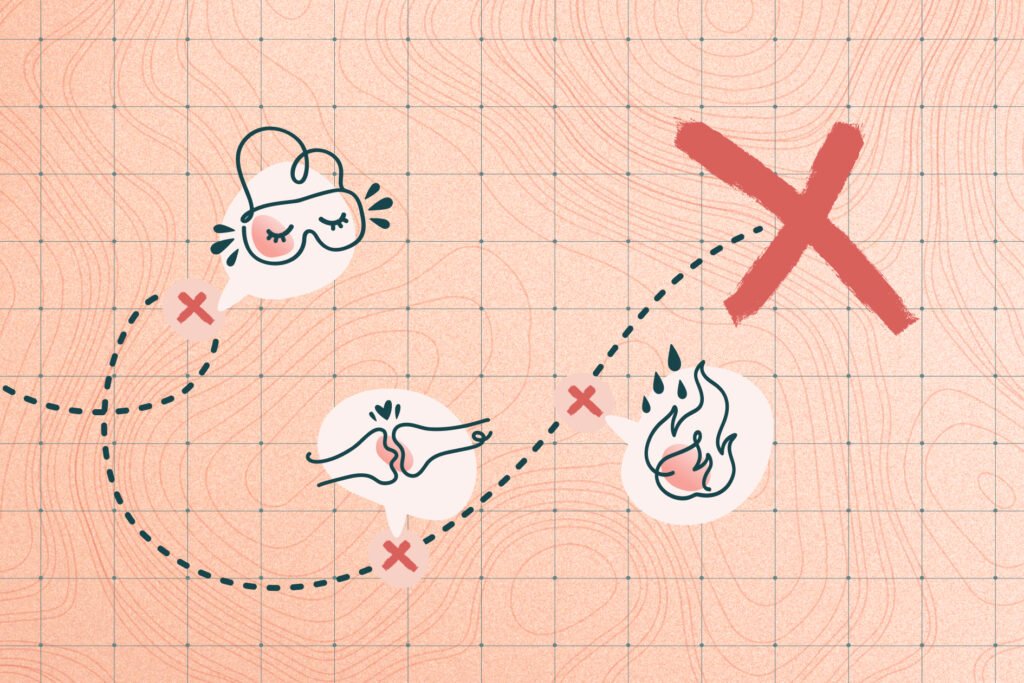
Dr. Jeanne Bouteaud, menopause specialist at Coral, emphasizes that every woman’s “first” sign is different, but they typically cluster into these three experiences:
The “short-cycle” surprise
One of the most reliable early signs of perimenopause isn’t a missed period, it’s a shorter one. If your 28-day cycle suddenly becomes a 21 or 24-day cycle, your body is sending a signal.
Shortened cycles are often caused by a change in follicle-stimulating hormone (FSH) and a shorter follicular phase. This shorter phase is who you have to thank for that panic moment we’ve all had. You feel a warm sensation down there, your friend just showed up for an early visit, you’re wearing white pants and in the middle of a meeting…great!
Quick tip: Start tracking! Tracking your cycle and these unpredictable moments gives you two things: the awareness to support your body in real time, and the receipts you need to advocate for yourself when it matters most.
The 3:00 AM wake-up call
This isn’t just “stress.” Early perimenopause often manifests as a specific type of insomnia where you fall asleep fine but wake up in the middle of the night, often feeling a bit “wired”, due to a spike in cortisol and a dip in progesterone.
Quick tip: Resist the urge to reach for your phone. Blue light signals your brain to stay alert and makes it harder to fall back asleep. Instead, get up and move to another room until you feel genuinely sleepy. It sounds counterintuitive, but staying in bed while awake teaches your brain that lying awake there is normal, and that’s a habit worth avoiding.
The “short fuse” feeling
You might notice a decrease in your resilience to stress. If things that used to be minor annoyances now feel like major provocations, it’s often due to the fluctuating estrogen levels affecting your brain’s serotonin regulation.
Quick tip: Before you blame your boss or your inbox, check in with your cycle and take a break. In these moments, even a 5-minute walk outside can help. Physical movement supports serotonin regulation naturally.
What are the symptoms of perimenopause?
You have estrogen receptors in almost every tissue in your body, which is why perimenopause can feel like a full-body system update that no one asked for. If you’ve searched for “what are the symptoms of perimenopause,” you’ve likely felt a mix of relief (no, it’s not in your head!) and overwhelm at how much this transition can affect your body and mind. While some sources even cite up to 100 symptoms of perimenopause, most clinical research clusters them into specific categories. These symptoms are all connected to the same shifting foundation: your hormones.
The “big three”
These are the classic signs most people associate with the transition:
- Hot flashes: sudden waves of heat, often starting in the chest or face.
- Night sweats: severe hot flashes at night that can result in “sheet-changing” levels of perspiration.
- Irregular periods: the hallmark of the transition. Cycles that are shorter, longer, heavier, or lighter than your “normal”.
Emotional & cognitive shifts
Often the most distressing, these can be misdiagnosed as primary clinical depression or “just stress.”
- Brain Fog: Difficulty focusing or feeling “spaced out.”
- Memory Lapses: Forgetting names, dates, or why you walked into a room.
- Mood Swings: Sudden shifts in emotional state, often without an external trigger.
- Heightened Anxiety: A new sense of “on-edge” dread or localized panic.
- Irritability: A noticeably lower resistance to daily annoyances.
- Depressive Episodes: Feelings of sadness or apathy linked to estrogen fluctuations.
- Panic Attacks: Intense, physical manifestations of anxiety that can feel like a heart event.
Physical & somatic changes
- Fatigue: A bone-deep exhaustion that sleep doesn’t seem to touch.
- Sleep disruptions/insomnia: Difficulty falling or staying asleep (often the “3:00 AM wake-up”).
- Weight gain: Specifically a redistribution of weight to the abdominal area.
- Bloating: Increased gas and a feeling of “fullness” in the digestive tract.
- Breast tenderness: Soreness or sensitivity similar to early pregnancy or PMS.
- Headaches & migraines: An increase in frequency, often linked to cycle timing.
- Joint pain: Aches and “creakiness” in the knees, hips, or hands.
- Muscle tension: Feeling “tight” or sore as if you’ve over-exerted yourself.
- Dizziness: Occasional bouts of vertigo or feeling lightheaded.
- Changes in body odour: A shift in how your sweat smells, often becoming more pungent.
- Osteoporosis risk: While you can’t “feel” bone density loss, it is a clinical symptom of the late transition.
Skin, hair and oral health
- Hair thinning: Noticeable loss of volume on the head, or new “stray” hairs on the chin. Does anyone else keep tweezers in the car?
- Brittle nails: Nails that crack, peel, or break more easily than before. God bless Shellac!
- Itchy skin: A crawling or itchy sensation (formication), often without a visible rash.
- Dry skin: A loss of elasticity and moisture in the skin barrier.
- Burning mouth syndrome: A metallic taste or a literal burning sensation on the tongue or roof of the mouth.
- Gum problems: Increased bleeding or sensitivity in the gums.
Sensory & neurological gaps
- Electric shock sensations: A feeling like a “zap” under the skin or in the head, often preceding a hot flash.
- Tingling extremities: A “pins and needles” sensation in the hands or feet.
- Irregular heartbeat: Heart palpitations or a feeling like your heart is “skipping a beat.”
- Allergy changes: New sensitivities or an uptick in seasonal allergy symptoms.
Sexual & genitourinary health (GSM)
- Vaginal dryness: Thinning of the vaginal walls (atrophy) that can make intercourse painful.
- Urinary urgency: Feeling like you need to go more often or experiencing “leakage” when you sneeze.
- Low libido: A physiological drop in desire, often compounded by the fatigue and dryness mentioned above.
Why it’s happening
There is a very specific biological reason for the chaos, and it starts with a breakdown in communication between your brain and your ovaries.
Imagine you’re in a group chat with three of your oldest friends. Usually, the vibe is chill. You check in, you coordinate a dinner, you move on. Boring, but functional.
Then, suddenly, the group chat enters its “Chaos Era.”
Friend A starts double-triple-quadruple texting because she isn’t getting a reply. Friend B has completely muted the notifications and is ghosting. Friend C is having a mid-life crisis. One minute she’s sending 15 voice notes about how much she loves everyone, and the next she’s leaving the chat without explanation.
That “buzz” in your pocket that makes you want to throw your phone across the room? That’s exactly what’s happening in your endocrine system. Perimenopause has entered the chat.
Perimenopause is a communication breakdown in the world’s most dramatic group chat. Your brain is the friend screaming through the “radio silence” of your ovaries, and the resulting chaos is what triggers everything from your night sweats to that feeling that everyone is suddenly chewing too loudly. Should we start bringing ear plugs to dinner?
The key players in your hormonal “Group Chat”
To understand your perimenopause symptoms, you have to understand the three hormones currently fighting for the last word. This is the science behind the “vibe shift”:
- FSH (the double-texter): As your egg reserve decreases, your brain produces more Follicle Stimulating Hormone (FSH) to try and get a response from the ovaries. High FSH levels are essentially your brain “shouting” into the group chat, trying to force an ovulation that isn’t happening on schedule.
- Estrogen (the mood-swinger): In your 20s and 30s, estrogen levels were a gentle wave. In perimenopause, they become a rollercoaster (buckle up). You might have “Estrogen Dominance” one week (heavy periods, breast tenderness) and a total crash the next (hot flashes, dry skin).
- Progesterone (the peacemaker who ghosted): Progesterone is your “chill” hormone. It helps you sleep and keeps your mood stable. In the perimenopause transition, progesterone is often the first to leave the chat. When it dips, your resistance to stress vanishes.
Signs of menopause: how they differ from perimenopause
We often use these terms interchangeably in casual conversation, but clinically, they are distinct chapters. If perimenopause is the roller coaster ride where your hormone levels (and your mood) are loop-the-looping, menopause is the moment the ride finally comes to a full stop. You’ve reached a new, stable baseline. Even if that baseline feels different than it did in your 30s.
Perimenopause is a state of being. You are actively experiencing shifts, irregular cycles, and fluctuating symptoms.
Menopause is a single point in time. It is defined as the 12-month anniversary of your very last period. Good-bye tampons and hello to your new period-free existence!
Key differences in symptoms
While perimenopause and menopause symptoms can overlap, the way you experience them tends to shift.
Predictability vs. surprise
In perimenopause, a hot flash might strike out of nowhere during a heavy, painful period. In menopause, periods have ceased entirely, but vasomotor symptoms (like hot flashes and night sweats) often become more consistent as your body adjusts to a permanent low-estrogen environment.
No more bleeding
One of the most horrible perimenopause symptoms is “flooding” (extremely heavy, unpredictable bleeding). In menopause, this disappears. If you experience any vaginal bleeding after your 12-month milestone, it is no longer a “period” and requires an immediate check-in with a healthcare provider.
Shift to GSM
While brain fog and irritability may begin to stabilize as the “hormonal noise” of perimenopause quietens, symptoms like vaginal dryness or urinary urgency (Genitourinary Syndrome of Menopause) often become more prominent. These signs of menopause are progressive, meaning they don’t typically resolve on their own without proactive care.
Think of perimenopause as the journey, and menopause as the arrival. The transition can be gruelling, but reaching the milestone of menopause brings a level of hormonal predictability that many women find relieving. It is the beginning of your second act. We like to call this the ‘I don’t give an F’ era. It’s time to finally prioritize yourself. A good place to start is your muscle and bone health, if you haven’t already.
Early symptoms: recognizing the transition in your 40s
If you’re in your early 40s and feel like the “dashboard lights” of your body are flickering, you aren’t imagining it… and you aren’t “too young” for this to potentially be hormonal.
The biggest hurdle for women in their 40s is the dismissal. Because you likely still have a regular-ish period and aren’t experiencing stereotypical hot flashes, many healthcare providers (and even friends) might tell you it’s just “burnout,” “parenting stress,” or “the weight of the world.”
While those things may definitely be true, they are often exacerbated by the very real early symptoms of perimenopause specifically, the menopausal transition.
The “invisible” early menopause symptoms
When we talk about early menopause symptoms, we aren’t just talking about the end of fertility. We’re talking about these subtle, often misattributed shifts: short fuse, insomnia, fatigue, changes in your cycle. Essentially, everything we covered at the beginning of this guide.
Don’t let anyone dismiss your experience. If you feel like your “battery” is draining faster than it used to, or your patience has evaporated, look at your calendar and your cycle. Recognizing these as hormonal shifts allows you to prioritize management (like MHT or lifestyle adjustments) before the symptoms become too much to handle.
Signs of menopause at 40: is it too early?
While reaching menopause at 40 is considered premature, starting the perimenopausal transition in your early 40s is entirely possible.
There is a persistent myth that menopause is a “50s problem”. However, for many women, the “chaos in the group chat” we talked about earlier begins much earlier. If you are noticing shifts in your late 30s or early 40s, you aren’t “broken”, you are likely entering the early transition phase.
Understanding the age categories
- Premature Menopause: Clinicians call this Primary Ovarian Insufficiency or POI. This is defined as reaching the milestone of menopause (12 months without a period) before the age of 40. This affects about 1 to 3% of women and requires distinct clinical management to prioritize long-term bone and heart health.
- Early menopause: reaching menopause between the ages of 40 and 45.
- The early transition: starting perimenopause in your early 40s is the standard experience for a significant portion of the population.
Recognizing symptoms of perimenopause
By late 40s, many women are deep in the “early transition”. At this stage, you likely haven’t stopped menstruating, but you are experiencing the “regularly irregular” nature of fluctuating hormones.
Specific symptoms of perimenopause at 40 often include:
- Your consecutive menstrual cycles vary in length by seven days or more.
- You experience crashing fatigue during the day, yet your sleep is disrupted by early morning wakefulness.
- A small increase in irritability or new-onset anxiety that feels chemically driven rather than situational.
Why early recognition matters
Learning about signs of menopause and perimenopause in your 40s is a proactive step. Because the transition can last for over a decade, identifying these early markers allows you to build a management plan before the symptoms become so severe that they impact your career and relationships.
Emotional and cognitive signs of perimenopause
If you feel like your brain is not working as it used to or your personality has been hijacked, your neurochemistry is responding to a fluctuating hormone supply.
While hot flashes get all the press, the emotional and cognitive perimenopause symptoms are often the most disruptive to a woman’s career and relationships. Because these signs (like brain fog and irritability) peak around age 44, they are frequently misattributed to the “stress of the sandwich generation.” At Coral, we believe in calling them what they are: a physiological response to the decline of estrogen and progesterone.
The brain fog
You walk into a room and forget why; you struggle to find common words in a meeting. This isn’t early-onset dementia but the result of estrogen, which helps fuel glucose metabolism in the brain, becoming inconsistent.
New-onset anxiety
Many women who have never struggled with anxiety suddenly experience a buzzing, localized sense of dread. This is often linked to the drop in progesterone, your body’s natural “anti-anxiety” hormone.
Mood changes in menopause & transition
This isn’t just “PMS on steroids.” These are significant shifts where your “stress floor” drops. Things that used to be manageable now feel like personal provocations.
It’s all in your neurotransmitters
Research (1) shows that estrogen helps regulate serotonin and dopamine, the chemicals that keep you feeling stable and motivated. When estrogen levels fluctuate wildly during the transition, your brain’s “thermostat” for mood and focus gets recalibrated, often leading to the mood changes in menopause that make you feel like you are 13 again (did I really just slam that door?).
Symptoms of premature menopause: when it happens before 40
Reaching menopause before age 40 is rare (affecting about 1 to 3% of women), but it requires a much more proactive medical strategy to protect your long-term health.
While we’ve discussed how the transition often starts in the mid-40s, “premature menopause”, clinically referred to as Primary Ovarian Insufficiency (POI), is a different category. If you are under 40 and your “predictable patterns” have vanished, this isn’t a phase to “wait out.” It is a signal to prioritize a clinical conversation immediately.
POI vs. early menopause: know the difference
It is easy to get these terms tangled, but the distinction matters for your treatment plan:
- Premature menopause (POI): occurs before age 40.
- Early menopause: occurs between ages 40 and 45.
If you are experiencing early menopause symptoms in your early 40s, you are on the younger side of “typical.” If you are experiencing them in your 30s, it is considered premature.
Recognizing the symptoms of premature menopause
Because the drop in estrogen happens earlier and often more abruptly than a “natural” transition, the symptoms of premature menopause can feel particularly intense:
- Sudden vasomotor spikes: Intense hot flashes and night sweats that disrupt your ability to work or sleep.
- The “vanishing” period: Unlike the long, drawn-out cycle changes of perimenopause, premature menopause may involve periods that simply stop or become extremely infrequent very quickly.
- Mood & cognitive whiplash: A sudden onset of “brain fog” or severe anxiety that feels disconnected from your actual life circumstances.
- Physical dryness: Rapid changes in skin elasticity and significant vaginal dryness (GSM) that can make intimacy painful.
Why we can’t ignore the timing
Estrogen is a “multitasking” hormone. It doesn’t just manage your cycle; it protects your brain, your heart, and your bones. When menopause occurs before 40, your body loses that protective shield much earlier than intended. This increases the long-term risk of osteoporosis and cardiovascular disease. This is why moving quickly to get a proper diagnosis and discussing Menopausal Hormone Treatment (MHT) isn’t just about symptom relief; it’s about longevity.
How to track your symptoms and get a diagnosis
If you’ve walked into a doctor’s office feeling like a different person only to be told your “labs are normal,” you’ve experienced the biggest gap in modern women’s healthcare. At Coral, we believe your symptoms aren’t just “noise”, they are the most important data points you have.
Remember that Hormonal Group Chat from Hell we talked about? Where the brain is double-texting and the ovaries are ghosting?
Imagine trying to settle a massive argument in that chat by only looking at the very last message sent. You’d have zero context. You wouldn’t know who started the drama, how long it’s been going on, or why everyone is suddenly so sensitive. You’d probably just tell everyone to “calm down” which is exactly what happens when a doctor looks at a single, “normal” blood test and tells you it’s just stress.
To get a real perimenopause diagnosis, you can’t just look at a “read receipt” (your labs). You have to scroll up. You need to look at the chat history (the patterns, the spikes, and the silences over weeks and months) to see the full story of what’s actually happening.
How to become your own best advocate
While many people search for a “perimenopause test,” the reality is that there isn’t one single gold-standard blood draw that can confirm you’re in the transition. Your hormones are in a volatile “Chaos Era,” meaning your levels might be high on Tuesday and bottomed out by Thursday.
Blood test limitation
A doctor might test your FSH (Follicle-Stimulating Hormone). If it’s consistently high, it’s a strong indicator. However, in early perimenopause, FSH can fluctuate wildly. A “normal” result doesn’t mean you aren’t in the transition; it just means the doctor “checked the chat” during a rare moment of silence. That’s why we look at your whole journey, not just one test.
Symptom tracking: your “chat history”
If you want to advocate for yourself, you need a paper trail. This is where data-driven tracking becomes your best friend. Instead of saying “I feel off,” you can show the patterns:
- The “double-texting” phase: Track when your cycles shorten (a sign of rising FSH).
- The “ghosting” phase: Log the 3:00 AM wake-ups and anxiety (the signs of disappearing progesterone).
- The “drama” phase: Monitor the mood swings and brain fog relative to your physical symptoms.
Taking control of the conversation
We know you wanted answers yesterday.
But because this transition can last a decade, you don’t need a one-off “test”, you need a healthcare partner. For too long, women have been told to just “deal with it”—to stay on mute while the hormonal group chat blows up their life. We’ve been told that our “labs are normal” and that our symptoms are just the price of entry for midlife.
At Coral, we’re changing that narrative. You aren’t just a participant in this chaotic conversation; you are the Admin. By tracking your data, understanding the science of the “vibe shift,” and advocating for evidence-based care like MHT, you’re taking back control.
You don’t have to white-knucle your way through menopause.. If you’re ready to stop guessing and start managing, we’re here to help you navigate the data. No “pink-washing,” no dismissals, just the care we all deserve.
Disclaimer: The information provided here is for informational purposes only. It is not intended as medical advice. Always consult with your doctor or healthcare provider to determine what is best for your individual health needs.
While we use the word “women” for simplicity, we recognize that menopause and perimenopause can affect people of many gender identities. Our goal is to support everyone who experiences these changes.
- Bendis PC, Zimmerman S, Onisiforou A, Zanos P, Georgiou P. The impact of estradiol on serotonin, glutamate, and dopamine systems. Front Neurosci. 2024 Mar 22;18:1348551. doi: 10.3389/fnins.2024.1348551. PMID: 38586193; PMCID: PMC10998471. ↩︎